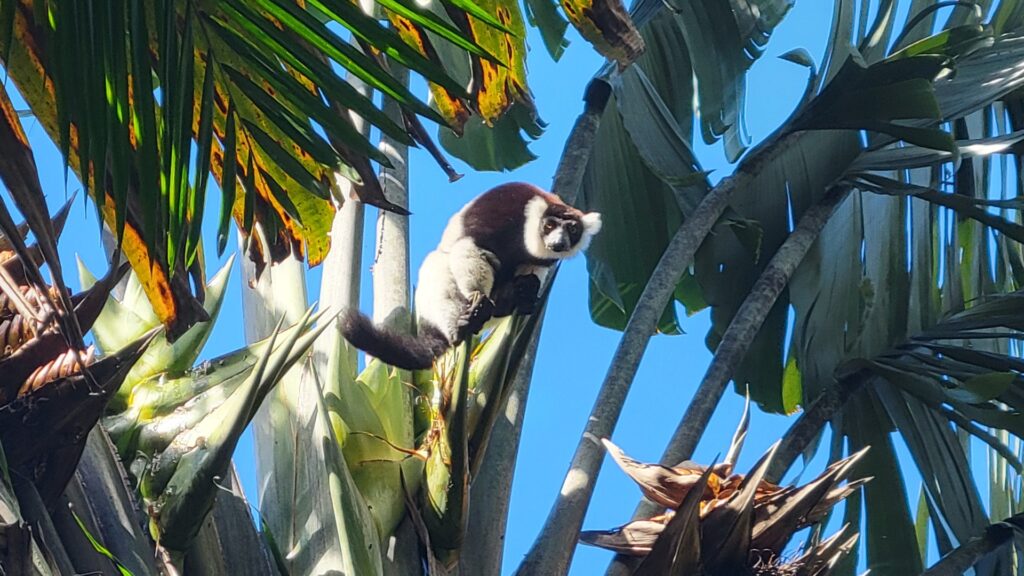
Three WashU researchers studying human-wildlife interaction in the forests of Madagascar have approached their research in a unique way – one that recognizes that protecting wildlife requires protecting people.
Assistant Professors of Biological Anthropology Krista Milich and Emily Wroblewski share a common interest in non-human primates. Both started at WashU at the same time and their path to Madagascar followed former Professor of Anthropology Robert Sussman, who was a prominent primatologist who studied Madagascar’s lemurs.
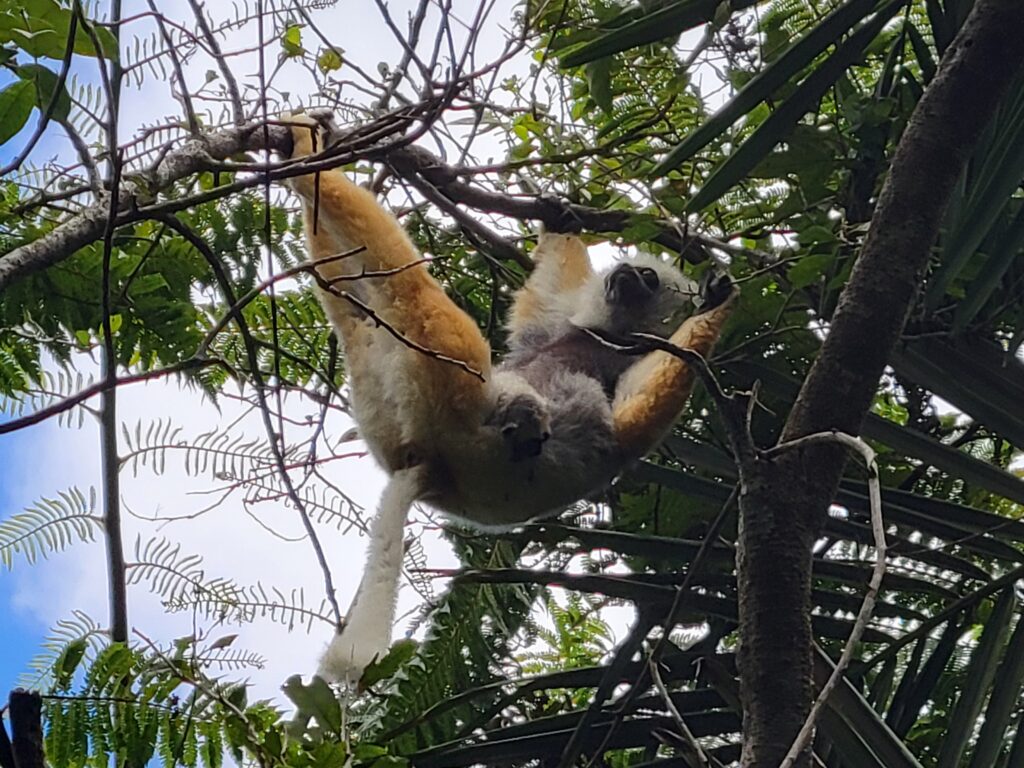
As a way to honor and continue that legacy, Milich and Wroblewski began collaborating with the St. Louis Zoo, the Missouri Botanical Garden and partner organization the Madagascar Fauna and Flora Group. The goal was to develop a project that studied threatened lemur species at two sites along Madagascar’s eastern coast.
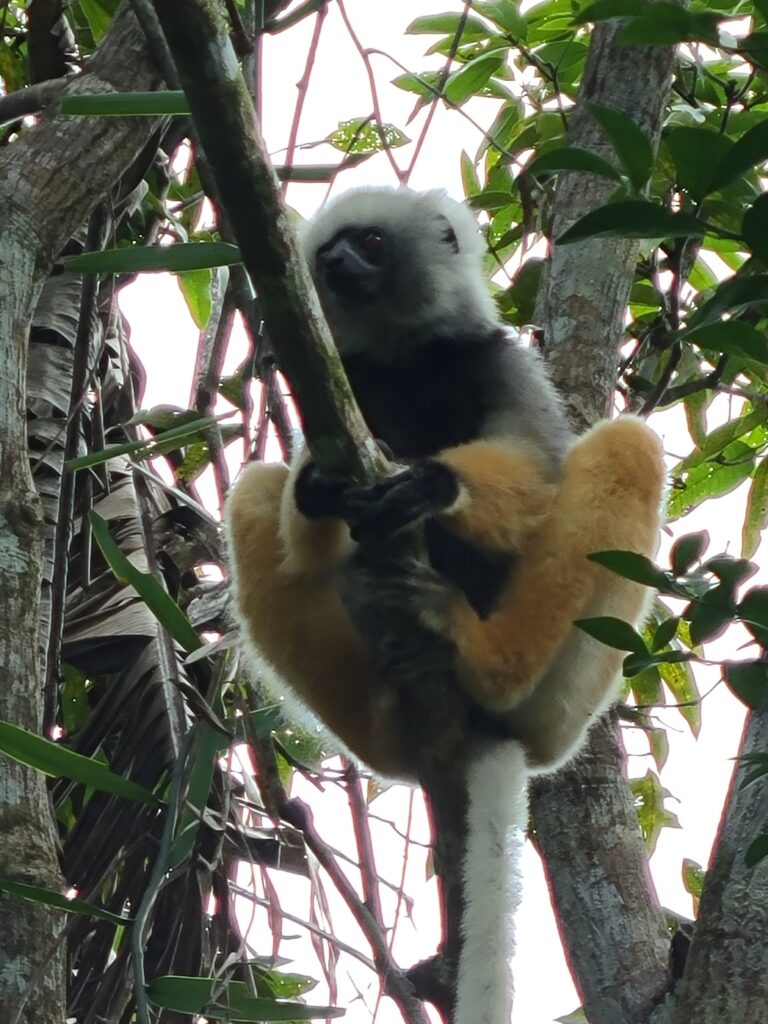
While the plants at these sites had been studied for years, no one had ever systematically studied the lemurs at the Vohibe site, despite knowing that numerous lemur species inhabited the forest. Since beginning their work, Milich and Wroblewski have studied at least 10 species of lemurs at Vohibe alone.
Their work also provided insight into human activities in the lemur’s habitat, where local communities in search of resources carried out slash-and-burn agriculture, mineral mining and hunting in the forest. For decades, the conservation field, at large, has used approaches that have focused on protecting animals and natural resources while overlooking the needs of human communities. Milich argues this approach is both ethically problematic and fundamentally ineffective.
“The reality is, we cannot achieve our conservation goals unless we deal with the reality that people are suffering,” Milich says. “We have to come up with solutions that work for people, the environment and wildlife.”
This recognition led Milich and Wroblewski to seek expertise beyond traditional primatology. At a workshop organized by the Center for the Environment on “Implementation Science & the Environment” in January 2025, Milich and Wroblewski met Ginger McKay, an assistant professor in the School of Public Health who specializes in implementation science—a field dedicated to understanding how evidence-based scientific knowledge is best adopted and sustained by communities.
“The Center for the Environment did their homework on who they thought might actually have some collaborative potential, and I would have probably never met Dr. McKay otherwise,” Wroblewski explains.