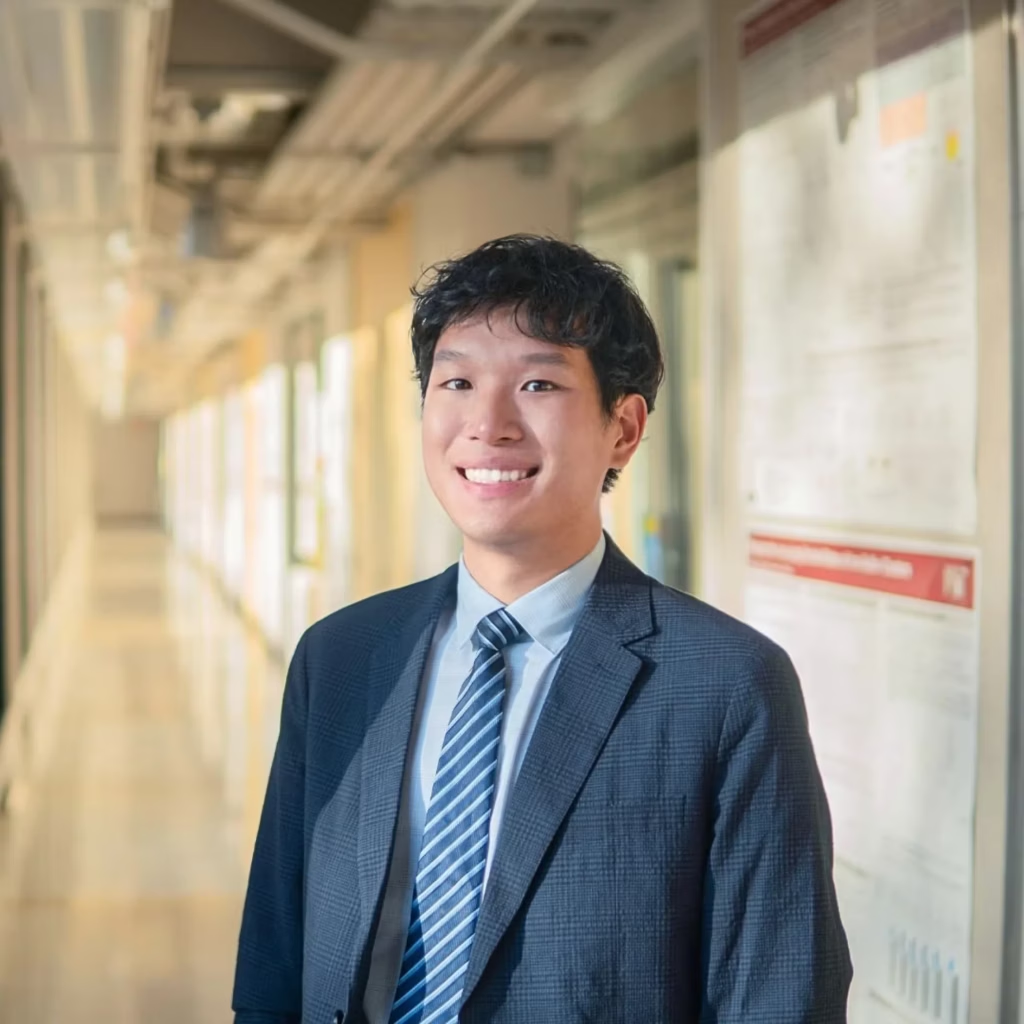
Zack Zheng Scholar Profile
Zhiling “Zach” Zheng is an assistant professor of chemistry and principal investigator of the Deep Synthesis Lab, a research team integrating AI with synthetic chemistry to accelerate the discovery of framework materials.
Zheng’s interest in chemistry began early. As a middle school student, he was fascinated by crystallization – a process that turns dissolved substances into solid, orderly structures. With his parents’ encouragement, Zheng experimented with “kitchen chemistry,” growing crystals of sodium chloride from household materials. Those experiences introduced Zheng to a love of chemistry and experiments.
As he progressed through his undergraduate studies, Zheng realized that crystallization could go far beyond familiar substances and could be used to create something that had never been discovered before. That realization led Zheng to focus on metal-organic frameworks (MOFs) during graduate school. MOFs are crystalline materials that can be customized at the atomic level, enabling scientists to use these “molecular sponges” with tailored structures to enhance properties such as selectivity and capacity for specific applications. The research at Zheng Group currently explores how these porous materials can address pressing global challenges, including removing pollutants from water or air and capturing CO2.
A defining milestone came during his PhD. After discovering that certain MOF materials could capture moisture from the atmosphere, he began to wonder whether the approach could be used to supply water in areas where it is scarce. That question led him to Death Valley National Park, one of the hottest and driest places on the planet. In August 2022, with temperatures reaching over 120 degrees Fahrenheit, Zheng and his collaborators tested their material under real-world conditions. Zheng describes the moment he first noticed water droplets forming in the desert air as unforgettable.
The breakthrough gained international recognition in 2025, when Zheng’s doctoral advisor, Omar Yaghi, received the Nobel Prize in Chemistry. The desert water harvesting work was highlighted during Yaghi’s Nobel lecture as a landmark example of the power of MOFs.
“For chemists, we spend 99% of our time making failures,” Zheng says. “It’s that 1% of the time that keeps us going.”
Zheng was drawn to WashU due to its emphasis on interdisciplinary research, which allows him to explore the unlimited possibilities of his AI and MOF research through collaboration with experts in engineering, environmental science, and health-related fields. Attending presentations, workshops, and info sessions hosted by the Center for the Environment has helped Zheng explore potential collaboration opportunities.
Zheng says, “The Center for the Environment is a good example of the interdisciplinarity of WashU because we have faculty from all different departments speaking and exchanging ideas.”
Connecting with fellow researchers at WashU opens the door for the discovery of new applications of porous materials, and as Zheng continues to build his lab and research at WashU, he remains driven by these possibilities.