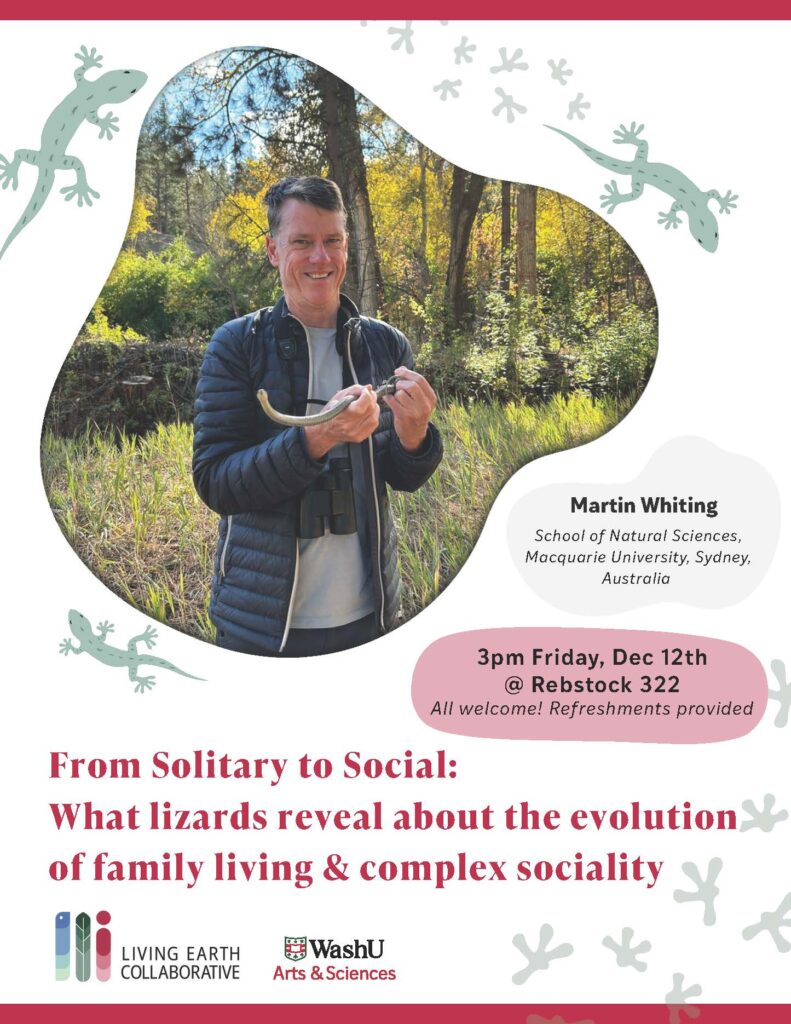
By: Martin Whiting – School of Natural Sciences, Macquarie University, Sydney, Australia
Description: Lizards offer a unique opportunity to better understand the early evolution of sociality and family living because unlike some mammals and birds with complex sociality and co-operative breeding, they have relatively simple forms of parental care and sociality. Among lizards, the Australasian Egernia group of skinks are particularly unique because they have a relatively high incidence of family living. They also have a wide range of sociality within a single clade, from solitary to pair-bonding to nuclear families and species that live in societies. My talk will span multiple scales, including field studies, behavioural experimental studies under semi-natural conditions, lab-based mechanistic studies of parent-offspring bonding, and finally, comparative studies that uncover the drivers of family living in lizards. I will discuss how particular traits and factors, such as viviparity, habitat availability, predation risk and signaling system all converge to facilitate the emergence of family living and complex sociality. And by extension, how relatively small changes to the physical and social environment can shape sociality.