WashU’s Sustainable Research and Practice Program
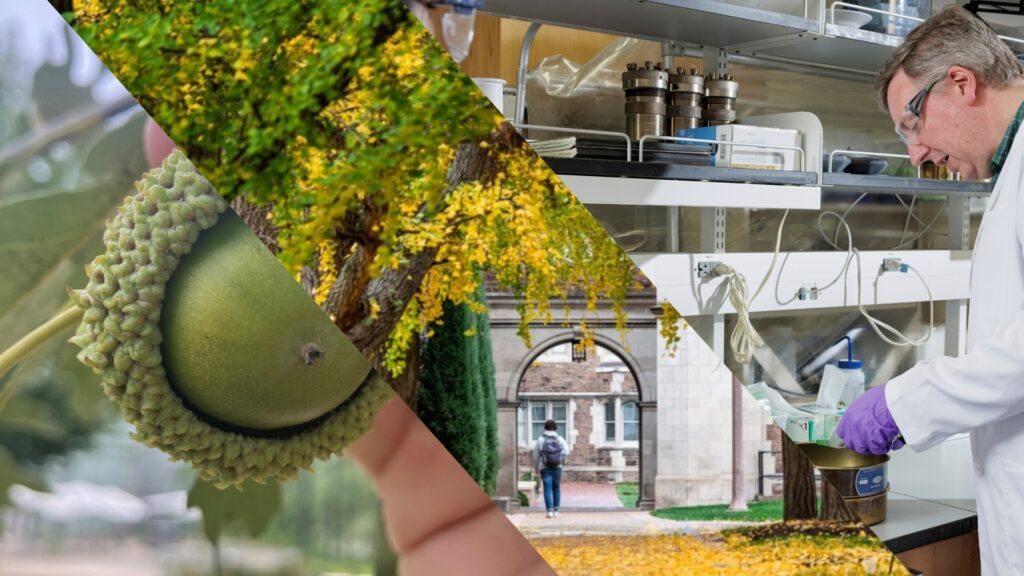
WashU’s Campus as Lab program (CAL) is a unique opportunity for students to stretch the traditional limits of their education to explore how the campus spaces beyond the walls of the classroom can be areas for learning, growth, and impact. The program leverages student and faculty research to identify innovative solutions to tackle sustainability challenges with implications on campus and in the broader field of practice.
The work done in this setting provides a critical connection point between research and practice. All CAL Student Fellows receive co-mentorship from university faculty, administrative staff, and WashU Sustainability practitioners. Student Fellows will synthesize their findings and present recommendations to WashU decision-makers. Through this experiential learning program, students will research and introduce environmental sustainability solutions, develop their professional skills as future leaders, and establish new and innovative practices on WashU’s campuses.
The Center for the Environment and WashU Sustainability are thrilled to collaborate on the launch of this program.
- How it works – for faculty
-
Faculty accepted or invited to participate in the program will be connected with a Sustainability staff liaison to interface with university administrators to support project outcomes. They will work with the Center for the Environment and Sustainability to hire a CAL Student Fellow. WashU Sustainability will onboard and orient the Student Fellows as part of the ESCC internship program during the academic year. During the summer, Student Fellows will integrate into the Summer Undergraduate Research Program cohort. The faculty advisor will be expected to orient the CAL Student Fellow to the project background, tasks, goals, and timeline when they begin. Faculty will schedule weekly check-ins with Student Fellows and provide guidance to ensure student success. Faculty will confirm periodic meetings for the student with the Sustainability staff liaison. Throughout the course of the project, faculty advisors will receive support from WashU Sustainability to identify opportunities to integrate findings and recommendations into practice.
- How it works – for students
-
Students will apply to CAL Student Fellow positions to work with a faculty member from a pre-populated list that will include either a research theme or a specific research question. Students will apply for a single semester with the possibility of extending to a second semester if the student and faculty member agree on the extension. Students will be expected to spend between five and ten hours per week on their projects and will be compensated at a rate of $15/hour. As part of the program experience, students will have touchpoints with relevant campus operational staff. Students in the CAL program will be integrated into the Environment, Sustainability, and Climate Change (ESCC) internship cohort which provides networking and professional development opportunities.
The Summer CAL Student Fellows will be integrated into the Center for the Environment’s Summer Undergraduate Research Program, which, like the ESCC program, provides network and professional development opportunities throughout the summer. These students will be expected to work on their projects full-time over the course of the 10-week program. Students will be compensated at the same rate as the Summer Undergraduate Research Program and receive the same accommodations.
- Implementation grants
-
Following the successful completion of a CAL project, faculty and Student Fellow teams can request up to $2,500 in implementation funding to advance the project’s recommendations.
- Project criteria & eligibility
-
Project criteria
- The project addresses an existing sustainability challenge
- A faculty mentor with relevant expertise is available to oversee the project
- The project leverages university physical or digital assets and requires input from or collaboration with a non-academic unit at WashU
- The project has the potential to shape the field of practice, including university operations
Project eligibility
These key components must be part of any CAL project:
- Identified research theme or specific question
- Student Fellow
- Faculty advisor
- Non-academic campus partner (WashU Sustainability can support relationship development)
- Sustainability staff liaison
Why a Campus as Lab program?
Campus as a Living Laboratory programs make use of an institution’s own infrastructure and operations as an educational opportunity for students. They provide a pathway for an institution to improve and innovate their internal practices, harnessing the knowledge and expertise of its own academy. WashU has supported living lab projects in many ways over the last two decades, including through internships, the Sustainability Exchange project-based course, and other courses. For years, WashU staff and faculty have developed additional avenues to support campus as lab activities. Now, through the generosity of the Cox-Young Family, WashU is able to formalize a CAL program to build on these past successes and to continue to advance research and practice.